

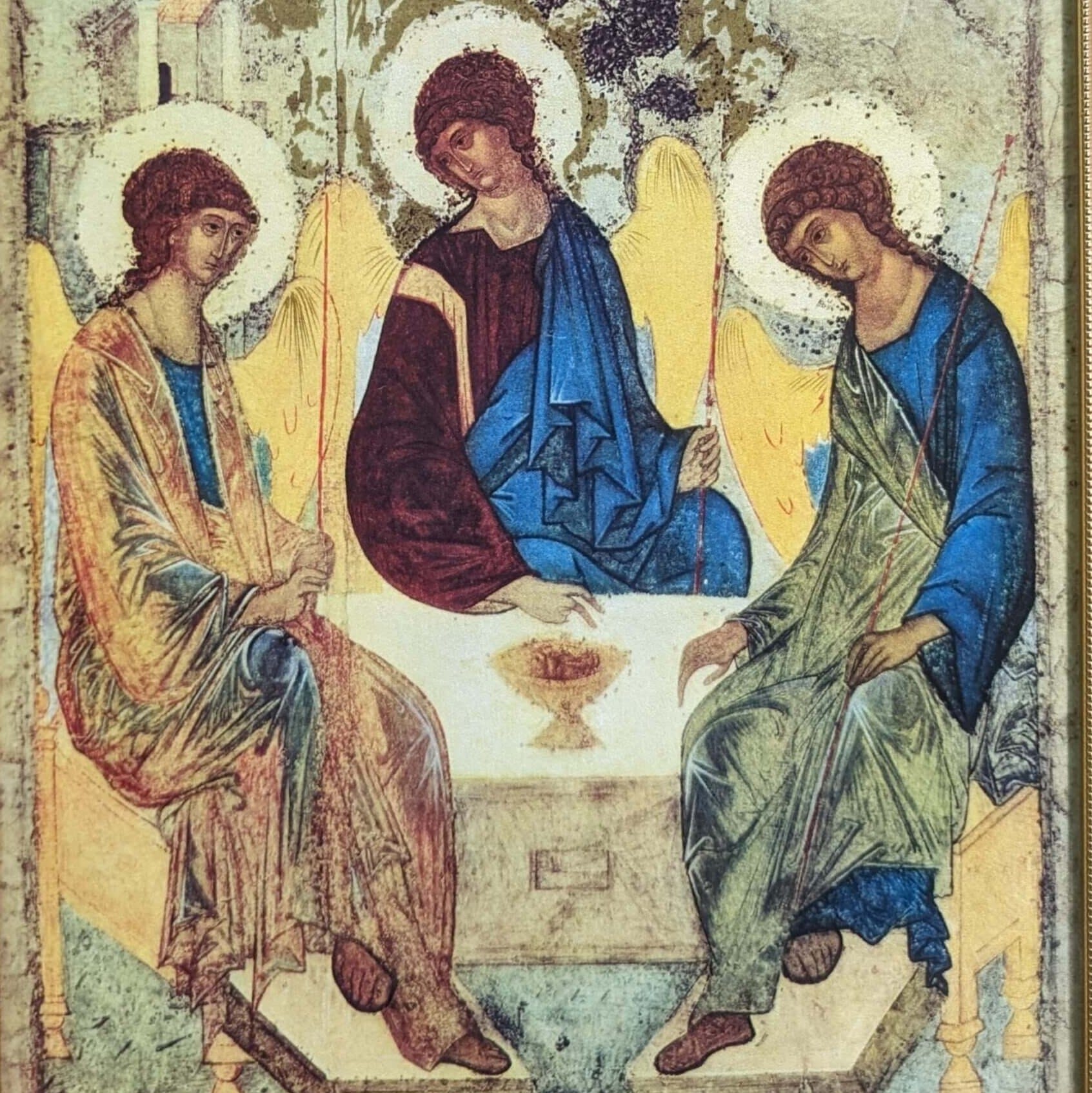
Last Sunday in Epiphany RCL - A: Exodus 24:12-18, 2 Peter 1:16-21, Matthew 17:1-9
On yet another mountain, Jesus is in a conversation with Moses and Elijah. In the Transfiguration story-icon, Moses and Elijah represent the Law and the Prophets, which Jesus said he came not to abolish, but to fulfill.1
Jesus’ presence and whole-hearted participation in a holy conversation with the Law and the Prophets2 is an invitation. To us. We are invited into that conversation.
Micah said that the Lord requires “justice” and “mercy.”3 But what exactly is “justice?” What does “mercy” look like, here and now? And what do those things require of us? Faithful and sincere people have different answers. Sometimes, faithful and sincere people cannot bear to even think about it. Perhaps because they see how much is at stake.
The Holy Conversation in which we seek the answers to those questions calls for prayer, reflection and action – undertaken alone and in community, with humility and a good dose of compassion for those who pray, reflect and act with us, and those who do not.
If the whole enterprise begins to feel overwhelming, we can look back to the Transfiguration story-icon. The disciples were afraid too. “But Jesus came and touched them, saying, ‘Get up and do not be afraid.’”
Wherever Holy Conversations may lead us, we will not go alone.
Peace.
The Law was God-given: an essential part of the covenant. Keeping the Law and growing in their understanding of it, God’s people learned how to live in right relation with one another and with God. Perhaps we understand devotion to the Law if we think of it as a sacrament: a God-given outward and visible sign of an inward and spiritual grace.
We’re often told that the Pharisees were “legalistic,” had no compassion for people and did not believe in a loving God. But “Jesus and the Pharisees agreed that God was compassionate and forgiving. What often distinguished Jesus from the Pharisees . . . was Jesus’ claim that he was the divinely authorized herald and executor of the restoration that was breaking in now.” Paul T. Sloan, Jesus and the Law of Moses, (Baker Publishing Group, Grand Rapids, MI 2025) at 25. “[B]ecause [Jesus] conceives the work of his mission as ‘greater than’ the work done in the temple (Matt.12:6), and because temple law overrides Sabbath law (12:5), [Jesus] argues that work done in service of his mission is permissible, and sometimes even required, on the Sabbath.” Jesus and the Law of Moses, at 32.
IOW, Jesus and the Pharisees didn’t disagree about God. They disagreed about who Jesus was and how the Law should apply to him.
The Prophets teach the deeper meaning of the Law.
Reflect, pray, reflect some more…. Talk with others, reflect and pray some more…. It then get up and DO.
As always, Lily, good food for thought!