

3rd Sunday after Epiphany RCL-A Isaiah 9:1-4, 1 Corinthians 1:10-18, Mtt. 4:12-23
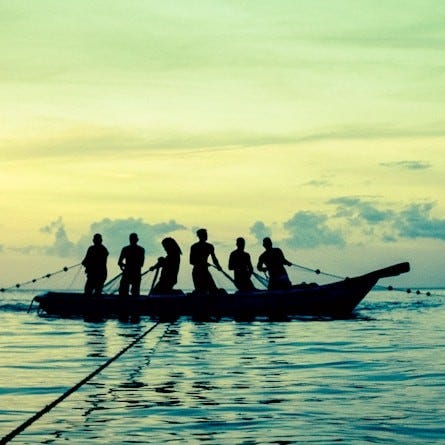
Jesus was about to start ushering in the Realm of God with preaching and teaching, so why not get some religiously-trained disciples? Why call fishermen?
Actually, I can think of a few good reasons. The fishermen undoubtedly knew how to whip up a good fish supper. And they had boats.1 They could manage on the water. They could help Jesus make a quick get away from crowds or Herod Antipas if he needed to.2
Fishing was a big industry around Capernaum. The fishermen may have been business-people: literate, even multi-lingual as you would expect of a business-person who lived in a multicultural corridor like Capernaum—Bethsaida.
If they were in the fishing business, they would have been part of a crew that knew how to work together and look out for each other. (Fishing could be dangerous: nets, knives, storms.) Or, maybe Jesus was just thinking about how often he wanted to be in a boat on the lake. Being quiet. Feeling the peace.
But why not call someone who had a boat and who was religiously-trained?
I’d bet that Jesus had tried to work with religiously-trained people: like the pharisees, the scribes or the rich young man. They seemed to have trouble seeing what mattered most to him.3
I’m pretty sure that what mattered to Jesus were the people who had never had religious training. Who had come to believe that their needs, their troubles and their hopes didn’t matter. Who had learned that even if they said, “I can’t breathe” it wouldn’t matter.4
Maybe Jesus wanted to make sure that he was always talking to those people about things that mattered to them. His new fishermen-disciples might or might not understand that, yet. But they would.5 In the meantime, they helped him do other needful things and their supper-time conversations must have been interesting.
One religiously-trained person eventually did receive a call to discipleship. That call was not a gentle one. To get that guy’s attention the Lord had to knock him off his horse.
And thanks to him, thanks to Paul, we hear this Sunday that it is in what the world dismisses as folly, futility and foolishness that the power of God is found.
Peace and be Good.
The newly called disciples left their fishing jobs behind, but they held onto the tools of the trade. More than once the gospels say they are in a boat on the Sea of Galilee, with their nets, fishing or just transporting Jesus to a different town.
Herod Antipas, the Herod who had John the Baptist killed, was the client-king of Galilee. Capernaum was in Galilee but right on the border with Gaulanitis and Iturea, regions governed by Herod’s brother, Philip. “Philip’s territories offered Jesus rest from his labors and an escape from the hand of Herod Antipas.” Brisco, Thomas V. Holman Bible Atlas (B&H Publishing Group, Brentwood Tennessee 1998) at 223. Jesus retreated several times with the disciples to Caesarea Philippi which was in one of Philip’s territories.
Ouch.
Fifty-five year old Geraldo Lunas Campos said “No puedo respirar.” It didn’t matter. He was killed in I.C.E. detention “during an altercation with guards.” Washington Post, January 22, 2026.
Soon enough they would be sent out on their own to “Cure the sick, raise the dead, cleanse the lepers, cast out demons.” Mtt.10:8.
What a neat image you’ve woven. Jesus wanted to make a difference with the people who had no hope and didn’t feel like they deserved any. Mother Theresa’s “untouchables”, Gloria Steinem and all of the other women around the world that led the “women’s movement”, MLK leading African Americans in the civil rights movement. Their current day leaders likely couldn’t see the needs of those left behind…. Did they even know they were leaving folks behind?