

Palm Sunday A1 - Zechariah 9:9-10, Philippians 2:5-11, Matthew 21:1-11
Roman citizens were generally not crucified because crucifixion was considered barbaric. Under Roman law, other people mattered less and for them, crucifixion was okay. In provinces like Judea, Romans often crucified non-citizens, slaves and troublemakers.2 Without trials.
Jesus was not a Roman citizen. I doubt that he got a trial.
Each gospel tells a trial story. Each account is a little different. Each is crafted to show the difference between Jesus’ vision and the understanding of those who were in power. The trial stories are dramas which make the point that the people in power didn’t get it.3
For Pilate, power was about how many soldiers he commanded. Jesus had no soldiers, so Pilate saw weakness. Pilate didn’t get it.
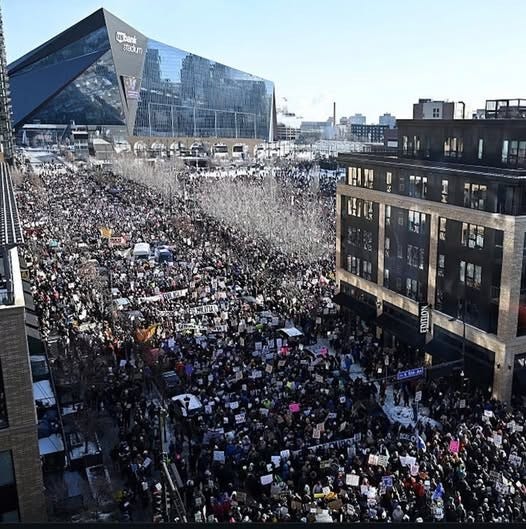
Thousands in Minnesota stood in bitter cold for weeks to protect neighbors who were being hunted, arrested, imprisoned or deported.4 ICE agents killed two protestors. The bloodshed might have continued: ICE had plenty of firepower.
Why didn’t ICE agents keep shooting? Perhaps because of the strength which protestors found in the truth that their neighbors mattered. ICE didn’t understand that truth, but they saw the strength it gave rise to. We need ICE agents to get it — to get the truth that our neighbors and their neighbors matter.
Protestors found strength in the truth that their neighbors mattered.
Jesus did not enter Jerusalem to become a victim, but to stand with those deemed not to matter. In the Holy Week story there is fear, cruelty and tragedy. But there is also love, faithfulness and the strength of standing in the truth.
The believers who wrote the trial narratives knew that the story would not end with the trial or even with the crucifixion. What Pilate saw as weakness would become the place where God’s power was experienced in a new way. The next chapter in the story was resurrection. We are part of that story, and it is not over yet.
Peace.
Readings are from the alternate rite for Palm Sunday, approved by the Episcopal Diocese of Massachusetts. They focus on Jesus’ entry into Jerusalem. A congregation may forgo reading the Passion gospel (i.e., the trial, crucifixion and death of Jesus). I think the alternate rite is a good change.
Chapman, David W., Schnabel, Eckhard Jr., The Trial and Crucifixion of Jesus: Texts and Commentary, (Hendrickson Publishers, Peabody, MA. 2019) at 532. According to Josephus, during the first Jewish War against the Romans (66-70 CE), the Roman commander Titus ordered the crucifixion of thousands of Judeans as a deterrent to insurrection and resistance. (Wars of the Jews 5:11.1).
Skinner, Matthew L., The Trial Narratives: Conflict, Power and Identity in the New Testament, (Westminster John Knox Press, Louisville, KY. 2010.)
In the first three months of this year, 42 people died in ICE detention. “Record deaths in US immigration custody expose systemic failures.” The Guardian (US) March 21, 2026. That is 10 more than the number of people who died in all of 2025. And 2025 was ICE’s deadliest year in two decades. The Guardian (US) January 4, 2026.
This is outstanding. thank you so much for your writing!
Thank you, Lily!